Trusted by thousands of creators worldwide







See the space. Understand the full property with Site Plans.
Immersive tours changed how buyers explore homes. But they don’t always answer the questions that come up—especially when exterior context is missing.

Questions agents and buyers still need answered:
- checkHow the home sits on the property
- checkHow interior and exterior spaces connect
- checkWhat’s included—and what isn’t
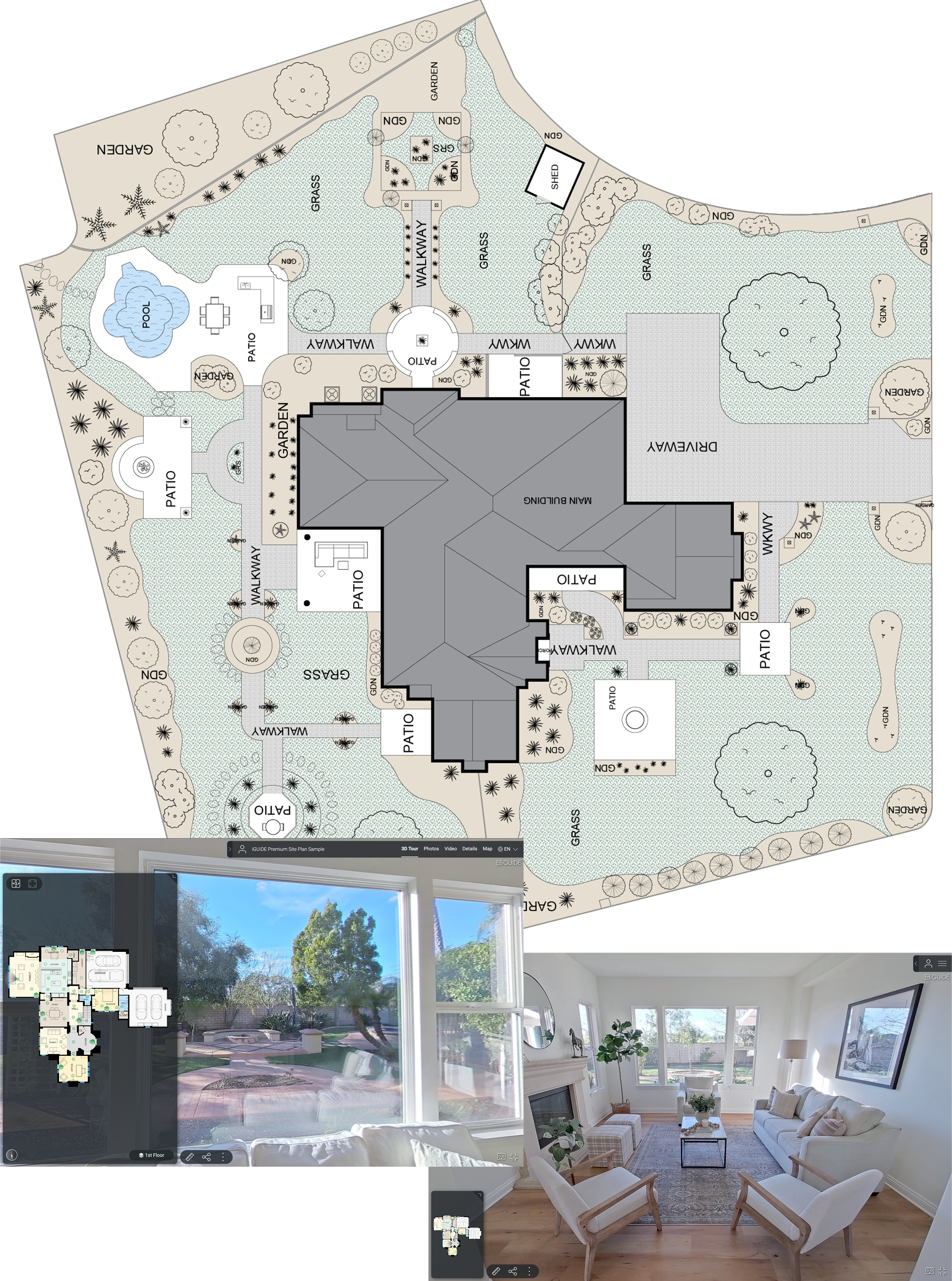
iGUIDE Site Plans extend immersive listings beyond the interior, showing the full property context buyers usually have to imagine. Listings feel more complete, transparent and easier to trust.
One capture. One complete listing.
iGUIDE Site Plans are generated from the same capture as the immersive walkthrough, so interior and exterior context stay aligned from a single session.
From the same source of truth, you get:
- checkInterior and exterior stay aligned
- checkExterior context buyers don’t have to imagine
- checkOne consistent listing experience with fewer questions
When everything comes from one capture, buyers feel more confident and can move forward with fewer unknowns.

I think it's cool because it gives buyers a chance to really look at the property. Sometimes the angle you grab in a photo can make the backyard look huge or really small—and then you walk out there and it's not what you expected. With a Site Plan, they can actually see what they're getting before they ever step foot on the property.
Mike Martin / Agent
InMotion Real Estate
Frequently asked questions
A Site Plan in real estate shows how a property sits on the land — including the building footprint, access points, and surrounding outdoor features. Unlike floor plans, which focus on the interior, Site Plans provide exterior context to help buyers understand the full property.
A Site Plan is different from a floor plan because it shows exterior layout and land context, while a floor plan shows the interior layout of a home. Used together, floor plans explain what’s inside, and Site Plans show how the home fits on the property.
No — iGUIDE Site Plans are not surveys or permit drawings. iGUIDE Site Plans are schematic, marketing-focused visuals designed to support buyer understanding and property listings, not technical or regulatory submissions.
Site Plans are created from the same iGUIDE capture used to generate floor plans and walkthroughs. Because everything comes from a single source of truth, Site Plans are produced without requiring an additional site visit or extra coordination.
Site Plans show visual layout and relative spatial relationships to help buyers understand the property. They are schematic, marketing-focused visuals and should not be used as certified measurements or legal representations.
Site Plans are used by real estate photographers, agents, and brokerages who want to provide buyers with clearer exterior context. They are especially useful for listings where land, access, or layout play an important role in understanding the property.
A Branded Property Overview is an optional, buyer-facing presentation that allows agents to add their branding to select listing assets. Site Plans can be included in a Branded Property Overview to create a clean, branded version that’s easy to share with buyers.
No — Site Plans are not required to use a Branded Property Overview. Branded Property Overview is an optional add-on for agents who want a branded, marketing-ready presentation and Site Plans can be included when relevant.
Site Plans are offered as a per-property add-on to iGUIDE Standard and Premium, giving real estate photographers a straightforward way to expand what they deliver on each shoot.Pricing is set per property and varies by region. As a reference, Site Plans are typically priced at:
- $25 AUD
- $35 USD
- $45 CAD
Because Site Plans are generated from the same iGUIDE capture, they can be added without additional time onsite, making them a simple, high-value deliverable photographers can offer to clients.
Boundary lines are estimates based on third-party data and are not guaranteed.
iGUIDEs with a Site Plan Add‑on for conventional lot sizes will be processed within 24 hours when all required data is uploaded to the iGUIDE Portal; however, this timeline may not apply to properties with more than 10,000 sq ft (929 sq m) of interior space, extensive acreage or complex site features. In such cases, delivery of the iGUIDE + Site Plan Add-on will depend on overall size and complexity and may exceed 48 hours.